 Skip to content
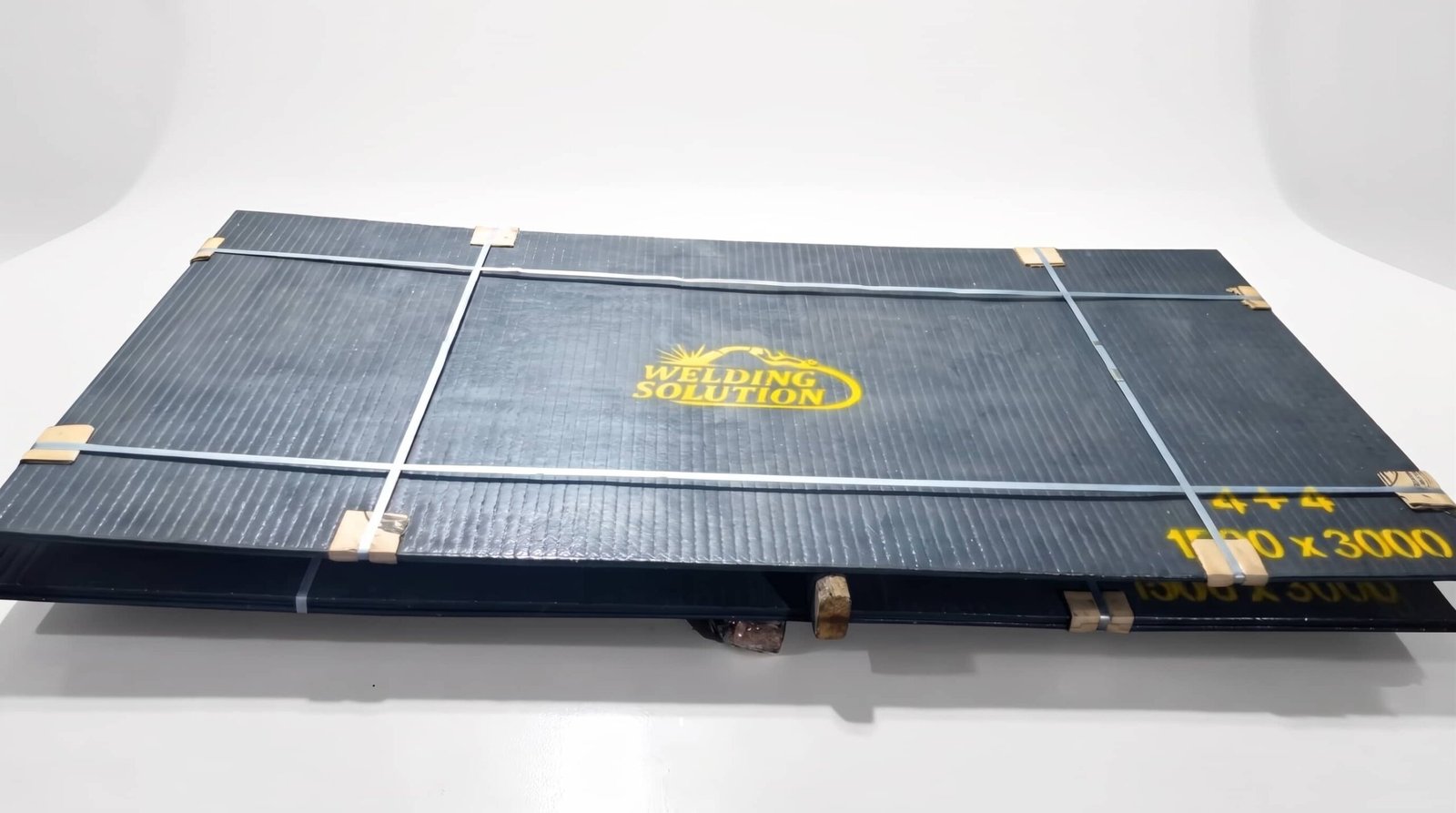


Engineered for the most punishing industrial environments, our chromium carbide wear plate (CCO plate) manufactured by Welding Solution delivers maximum resistance against extreme abrasive sliding wear, moderate impact, and erosive material flow. By metallurgically fusing an ultra-hard primary chromium carbide overlay onto a ductile structural carbon steel backing plate, each bimetallic chromium carbide wear plate provides 20–30× the service life of standard mild steel and 4–5× the working life of quenched and tempered AR400/500 plates.
Whether your facility operates vertical roller mills in cement plants, transfer chutes in mining operations, sugar mill shredder hoods, or exhauster fan housings in thermal power plants, our wear protection solutions eliminate costly unscheduled downtime and dramatically lower your total operating cost per ton.

Welding Solution Chromium Carbide Wear Plate with uniform stress-relief check cracking.
Every chromium carbide wear plate supplied by Welding Solution is produced with automated high-deposition welding technology. This guarantees consistent carbide formation, low base metal dilution, and high bonding strength between the hardfacing layer and the structural substrate.
| Technical Parameter | Standard FeCr-C Alloy | Complex Multi-Alloy (Nb, Mo, V, W) |
|---|---|---|
| Macro Hardness | 58 – 62 HRC (600 – 720 HV) | 62 – 66 HRC (700 – 850 HV) |
| Base Plate Steel | Q235B / ASTM A36 / Q345B (16Mn) | SS304, SS316, or High-Tensile Steel |
| Carbide Morphology | Primary M7C3 Hexagonal Carbides | Primary M7C3 + NbC & Mo2C precipitates |
| Carbide Volume Fraction | 40% – 50% | 50% – 60% |
| Thickness Combinations (Base + Overlay) | 3+3mm, 4+4mm, 5+5mm, 6+4mm, 6+6mm, 8+6mm, 8+8mm, 10+10mm, 12+12mm, up to 20+20mm (Custom ratios available) | |
| Standard Sheet Dimensions | 1400×2000mm, 1400×3000mm, 1500×3000mm, 2000×3000mm, 2200×3000mm (Custom CNC cut parts) | |
| ASTM G65 Wear Test (Procedure A) | 0.12 – 0.18 g mass loss max | 0.08 – 0.11 g mass loss max |
| Continuous Temperature Resistance | Up to 350°C (660°F) | Up to 650°C – 750°C (1200°F – 1380°F) |
The superior abrasion resistance of a high-grade chromium carbide wear plate depends on high concentrations of dissolved carbon and chromium. During solidification, hard hypereutectic M7C3 chromium carbides form with micro-hardnesses reaching 1500–1800 HV, locked inside an austenitic/martensitic matrix.
| Alloy Grade | C (%) | Cr (%) | Mn (%) | Si (%) | Refining Elements (Nb, Mo, V) | Fe |
|---|---|---|---|---|---|---|
| Standard FeCr-C Overlay | 3.5 – 5.5 | 22.0 – 32.0 | 1.0 – 2.5 | 0.8 – 1.8 | — | Balance |
| Multi-Alloy Complex Carbide | 4.0 – 6.0 | 25.0 – 35.0 | 1.2 – 3.0 | 1.0 – 2.0 | 5.0 – 10.0% (Nb + Mo + V + W) | Balance |
When choosing wear liners, maintenance managers often compare bimetallic composite plates against quenched and tempered steels (such as AR400, AR500, or Hardox®):
| Feature | Chromium Carbide Wear Plate (CCO) | Through-Hardened AR400 / AR500 Steel |
|---|---|---|
| Surface Hardness | 58 – 62 HRC (Overlay) | 42 – 50 HRC (400 – 500 HBW) |
| Sliding Abrasion Resistance | 4× to 6× longer wear life | Moderate service life |
| Temperature Resistance | Retains hardness up to 350°C – 750°C | Softens and loses hardness above 250°C |
| Cost-Efficiency | Lowest lifecycle cost per operating hour | Lower initial cost, but requires frequent liner swaps |
Welding Solution supplies custom-engineered chromium carbide wear plate assemblies across major process industries:
Because every chromium carbide wear plate utilizes a weldable structural backing plate, mechanical installation is fast and adaptable:
Cut using CNC high-definition plasma or waterjet. Standard oxy-acetylene cutting will not pierce the overlay face; if flame cutting is required on-site, always cut from the mild steel backing side.
Form into cylinders, pipes, or cones using standard 3-roll or 4-roll plate bending rolls. Plates can be bent with the overlay facing inward (minimum inner radius ~20× plate thickness) or outward.
Fasten using plug welding, rear welded threaded studs, or countersunk conical bolts with hardfaced caps that sit flush with the wear surface to prevent washouts.
Learn more about our industrial wear products and welding solutions at Welding Solution:
A chromium carbide wear plate incorporates hard M7C3 carbides with an overlay hardness of 58–62 HRC. In abrasive sliding conditions (such as raw material chutes, hoppers, and screens), it lasts 4 to 6 times longer than AR400 or AR500 steel, cutting down maintenance cycles and liner replacements.
Yes. Welding Solution offers complete CNC plasma cutting, drilling, countersunk holes, threaded stud welding, and rolling services. Send your CAD drawings (DWG/DXF/PDF) for custom fabrication.
Weld the structural backing plate using AWS E7018 low-hydrogen electrodes or ER70S-6 wire. For protecting weld seams or bolt head depressions on the hardfacing face, cap the joints with high-chromium hardfacing electrodes (AWS EFeCr-A1).
Standard thickness ratios include 3+3, 4+4, 5+5, 6+4, 6+6, 8+6, 8+8, 10+10, and 12+12mm in standard sheet sizes of 1400×3000mm and 1500×3000mm, with custom dimensions available upon request.
Contact our engineering team at Welding Solution for competitive pricing, technical specifications, and fast delivery on standard or custom chromium carbide wear plate orders.
 Optimized by Seraphinite Accelerator