 Skip to content
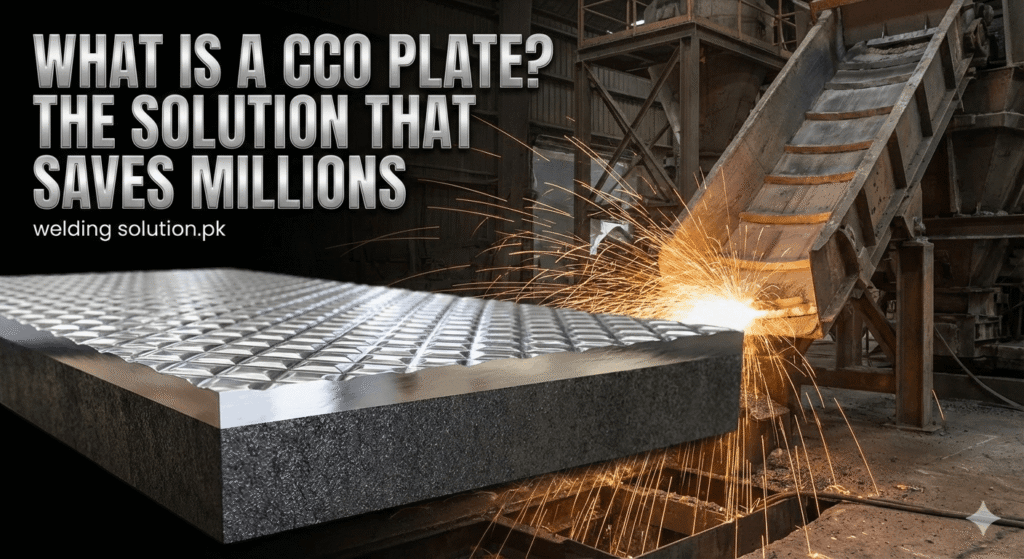
A CCO plate is a bimetal, wear-resistant steel plate whose top layer is fused with hard chromium–carbide crystals (typically 30–35 % chromium, 4–5 % carbon). Think of it as a diamond-hard shield bonded onto a tough, ductile base plate (usually mild steel).
Why it matters
In high-wear zones—chutes, hoppers, clinker coolers, crusher liners—the base metal alone erodes in days. A CCO overlay offers up to 8× longer service life, slashing unplanned shutdowns and skyrocketing replacement costs.
How CCO Plates Are Made
- Substrate prep – Low-carbon steel base (for easy welding).
- Overlay welding – Automated submerged-arc or open-arc hardfacing deposits multiple passes of chromium-carbide alloy.
- Stress relief & flattening – Removes residual stress for on-site formability (removing slag after welding).
- Precision cutting – Plasma or water-jet to custom shapes (hopper wear liners, bucket edges, screw flights).
CCO vs. Conventional Wear-Resistant Steel
| Feature | CCO Plate | AR400 / Hardox® 400 |
|---|---|---|
| Hardness (HRC) | 58–64 HRC (surface) | 42–45 HRC |
| Abrasion life | 5–8 × longer in sliding wear | Baseline |
| Impact tolerance | High (thanks to ductile mild-steel backing) | Medium |
| Heat resistance | Up to 600 °C continuous (overlay) | 1200 °C max | 400 °C max |
| Field repair | Simple plug-weld or field hardfacing on damaged spots | Requires whole-plate replacement |
| Cost per hour | Lowest—cap-ex slightly higher, op-ex drastically lower | Higher over equipment lifecycle |
Where CCO Plates Save Millions—Industry Hot-Spots
Cement Plants
- Clinker cooler liners, raw-meal chutes, VRM tables.
- Typical life extension: from 3 months to 18+ months.
- Saving = fewer shutdowns (each kiln stoppage ≈ US$150 k loss).
Coal Power & Handling
- Ash pipes, coal feeders, burner lines.
- Reduces fly-ash erosion and heat scaling, keeping boilers efficient.
- Fuel savings ~ 1 % = US$200 k / yr for a 500 MW unit.
Mining & Quarrying
- Truck bed liners, jaw-crusher cheeks, slurry pump casings.
- Downtime cost per haul truck: up to US$10 k/hr; CCO liners push rebuild intervals from weekly to quarterly.
Steel & Sinter Plants ◎
- Sinter screens, hot-screens, discharge chutes resist 700 °C dust streams.
Bulk Ports & Fertilizer Terminals ◎
- Ship-loader chutes and conveyors—salt & potash are highly abrasive.
Real-World ROI Snapshot
Case Study – Saudi Cement Kiln:
- Replaced AR400 liners in a tertiary air duct with 12 mm CCO.
- Cap-ex: +US$18 k (over AR400).
- Downtime saved: 4 unplanned shutdowns/year (14 hrs each).
- Net annual saving: US$540 k (production + labor + parts).
- Payback: < 2 weeks.

Choosing the Right Grade & Thickness
| Application | Overlay Thickness | Backing Plate | Recommended Grade |
|---|---|---|---|
| Chute/Hopper (coal, limestone) | 6 + 6 mm | Mild steel | CCO 60/6 (60 HRC) |
| VRM table & roller (cement) | 10 + 10 mm | Mild steel | CCO 63/8 |
| Truck tub & bucket liners (ore) | 8 + 10 mm | Mild steel | CCO 60/8 (impact) |
| High-heat sinter screens | 6 + 8 mm | Mild steel | Heat-resist CCO 600 °C |
Rule of thumb:
Sliding abrasion → thinner overlay
High-impact → thicker overlay with tougher carbides.
Key Takeaways & Next Steps
- CCO plates combine extreme hardness with a tough backing—perfect for perpetual abrasion zones.
- Typical payback is measured in weeks, not years, thanks to huge downtime reductions.
- In cement, coal and mining facilities across Pakistan, Bangladesh, UAE & Saudi Arabia, plants report 50–70 % lower maintenance spend after switching to CCO liners.
Ready to stop bleeding cash on endless liner replacements?
Contact Welding Solution—Asia’s trusted manufacturer of Chromium Carbide Overlay plates, heat-resistant wear sheets, and heavy-duty liners. Our engineers will map your wear zones, specify the right CCO grade, and deliver cut-to-fit plates within days to any site in the Gulf or South Asia.
Frequently Asked Questions
Q1: Can I weld CCO plates to existing AR steel?
Yes—maintain < 200 °C interpass, use low-hydrogen or stainless butter-layer for thick overlays.
Q2: How do CCO plates handle heat cycling?
Premium overlays retain hardness up to 800 °C; above that, switch to complex-carbide or ceramic wear tiles.
Q3: What sizes are available?
Standard: 1500 × 3000 mm, 8+4 to 20+20 mm. Custom plasma cut profiles ship factory-flat.
