 Skip to content


Engineered to combat severe sliding erosion and localized turbulence, our custom rolled chute and cyclone liners manufactured by Welding Solution provide tailor-made wear protection for non-planar, curved, and conical industrial housings. Using advanced heavy-duty plate rolling technology, we form bimetallic Chromium Carbide Overlay (CCO) plates into precise cylindrical sleeves, segmental cones, and complex curved transitions without flaking, delamination, or loss of overlay integrity.
Standard flat wear plates leave exposed gaps, facet joints, and irregular flow patterns that accelerate gouging wear at the seams. Our pre-curved and rolled wear liners deliver a continuous, smooth contour that mirrors your equipment geometry. By delivering an exact drop-in fit, Welding Solution liners outlast mild steel by 20–30× and quenched AR400/500 steel liners by 5–10×, dramatically reducing scheduled plant shutdowns and maintenance man-hours.

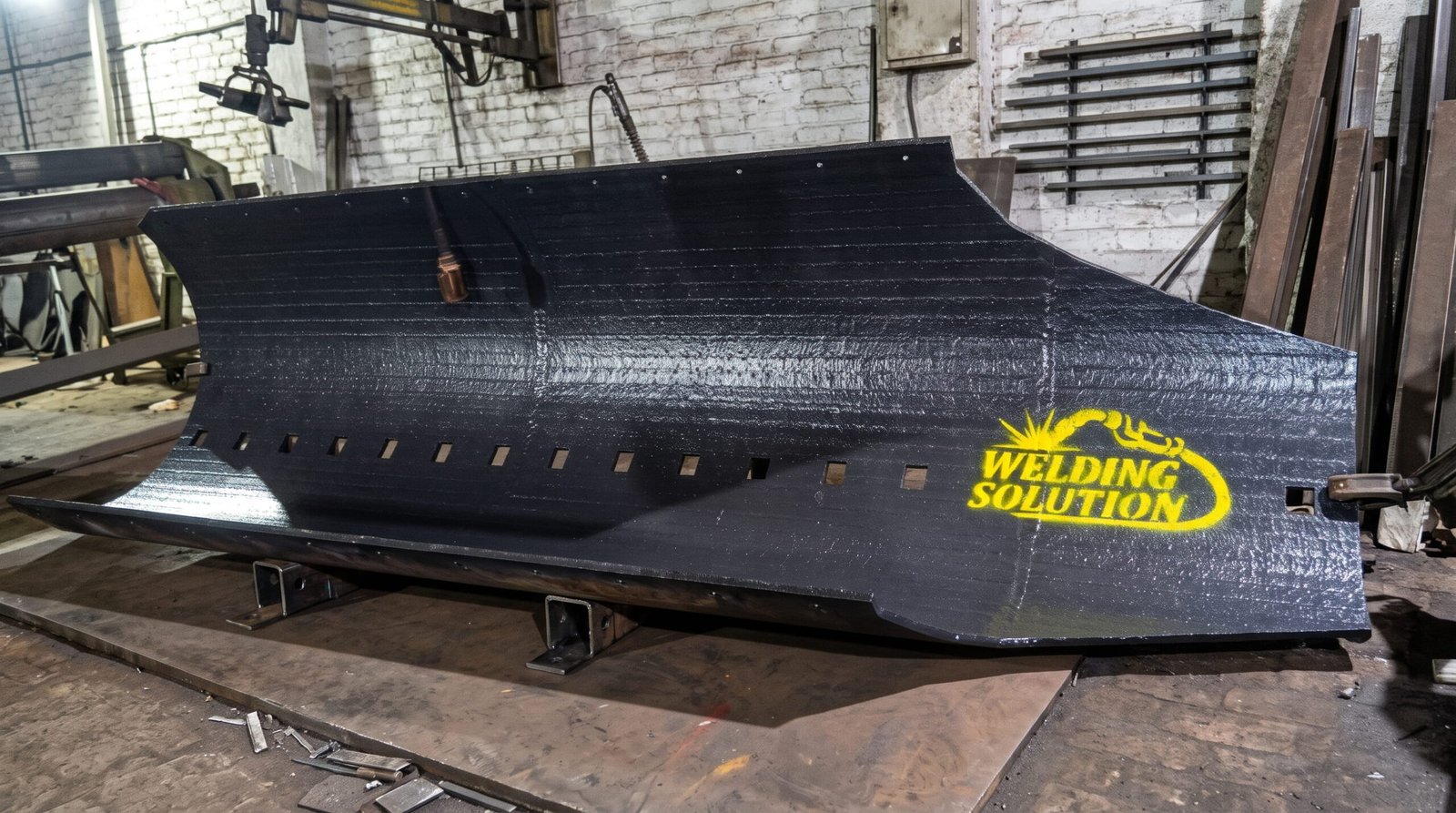
Precision-rolled chromium carbide cyclone cone and curved chute segments with controlled stress-relief micro-cracks.
Every liner assembly produced by Welding Solution is engineered to your exact CAD profiles or site measurements, combining structural weldability with extreme wear resistance:
| Parameter | Standard CCO Overlay Liner | High-Temperature / Complex Alloy |
|---|---|---|
| Hardfacing Macro Hardness | 58 – 62 HRC (600 – 720 HV) | 62 – 66 HRC (700 – 850 HV) |
| Backing Substrate Steel | Q235B / ASTM A36 / St 37-2 (Weldable Carbon Steel) | 16Mn, SS304, SS316, or High-Tensile Alloy |
| Rolling Geometry Options | Concave (Overlay on Inside / ID): For internal cyclone bodies, slurry chutes, and pipe bends. Convex (Overlay on Outside / OD): For external wear sleeves, scraper drums, and fan blade jackets. | |
| Minimum Rolling Radius |
Concave (ID wear): Minimum internal radius ≈ 15–20× total plate thickness. Convex (OD wear): Minimum external radius ≈ 20–25× total plate thickness. | |
| Common Thickness Combinations | 3+3mm, 4+4mm, 5+5mm, 6+4mm, 6+6mm, 8+6mm, 8+8mm, 10+10mm (Custom ratios engineered to weight limits) | |
| Formed Shapes & Geometries | Cylindrical roll shells, truncated cyclone cones, eccentric reducers, segmental mitered pipe elbows, square-to-round hoppers. | |
| Continuous Operating Temp. | Up to 350°C (660°F) | Up to 650°C – 750°C (1200°F – 1380°F) |
| Fastening / Fitment Methods | Rear-welded threaded studs (M12/M16/M20), countersunk conical bolt holes with hardfaced caps, plug weld cutouts, or perimeter fillet welds. | |
The extraordinary abrasion resistance of our custom rolled chute and cyclone liners originates from hypereutectic primary chromium carbides (M7C3) tightly packed within an austenitic/martensitic matrix:
| Alloy Grade | C (%) | Cr (%) | Mn (%) | Si (%) | Complex Elements (Nb, Mo, V, W) | Fe |
|---|---|---|---|---|---|---|
| Standard FeCr-C Hardfacing | 3.5 – 5.5 | 24.0 – 32.0 | 1.0 – 2.5 | 0.8 – 1.8 | — | Balance |
| Complex Carbide Alloy | 4.0 – 6.0 | 26.0 – 35.0 | 1.2 – 3.0 | 1.0 – 2.0 | 5.0 – 10.0% (Nb + Mo + V + W) | Balance |

Precision-rolled chromium carbide cyclone cone and curved chute segments with controlled stress-relief micro-cracks.
| Performance Factor | Welding Solution Rolled CCO Liners | Quenched AR400 / AR500 Steel | Ceramic (Alumina) Tile Liners |
|---|---|---|---|
| Erosion Resistance in Air/Slurry | Superior (Resists high-velocity particle impingement) | Moderate (Wears rapidly under fine particle erosion) | Excellent in pure sliding, poor in turbulence |
| Impact & Mechanical Shock | High (Absorbed by ductile steel backing) | High impact resistance | Brittle (Tiles crack and dislodge under lump impact) |
| Thermal Shock & Heat Limit | Up to 350°C (Standard) / 750°C (Complex) | Anneals and softens above 250°C | Bonding epoxy fails above 120°C |
| Installation & Replacement Speed | Fastest (Custom pre-formed drop-in segments) | Fast, but requires frequent replacements | Extremely slow (Labor-intensive manual tile gluing) |
Welding Solution manufactures custom rolled chute and cyclone liners for high-wear processing plants across Pakistan and international markets:
Complex conical cones and multi-segment bends are first modeled in 3D CAD, unwrapped into flat pattern developments, and precision-cut on high-definition CNC plasma tables before rolling.
Using hydraulic 3-roll and 4-roll bending machines with hardened roll tooling, plates are rolled incrementally to eliminate flat edges at joint seams, ensuring smooth concentric flow transitions.
Supplied with automated rear-welded threaded studs (blind fastening), countersunk conical bolt holes with protective hardfaced caps, or pre-cut plug welding slots to match existing structural casings.
Discover complementary wear products and welding supplies from Welding Solution:
Yes. Most of our cyclone cones, cylindrical pipes, and chute liners are rolled concave (hardfacing on the inside) where material abrasive flow occurs. We can also roll convex (hardfacing on the outside) for external wear parts such as rotating drums and agitator sleeves.
No. While high chromium overlay contains engineered transverse check cracks to release internal tension, the metallurgical bond between the overlay and the ductile structural base plate exceeds 300–400 MPa. Controlled incremental roll bending prevents any flaking or spalling.
We accept 2D CAD files (DWG, DXF), 3D models (STEP, IGES, SolidWorks), and detailed PDF engineering drawings. If CAD drawings are not available, our team can work from field measurements or sample templates.
We offer three standard installation methods: automated rear-welded threaded studs (clean wear surface without bolt heads), countersunk conical holes with hardfaced protective capping plugs, or perimeter welding to the shell.
Send your drawings or equipment dimensions to Welding Solution. Our engineering team provides fast turnaround on quotation, CNC pattern development, and drop-in wear assemblies.
 Optimized by Seraphinite Accelerator